> ## Documentation Index
> Fetch the complete documentation index at: https://docs.loisforword.com/llms.txt
> Use this file to discover all available pages before exploring further.
# Reasoning in Composer
> How the reasoning process behind Pincites Composer works for complex contract analysis, including step-by-step thinking, visibility, and output controls.
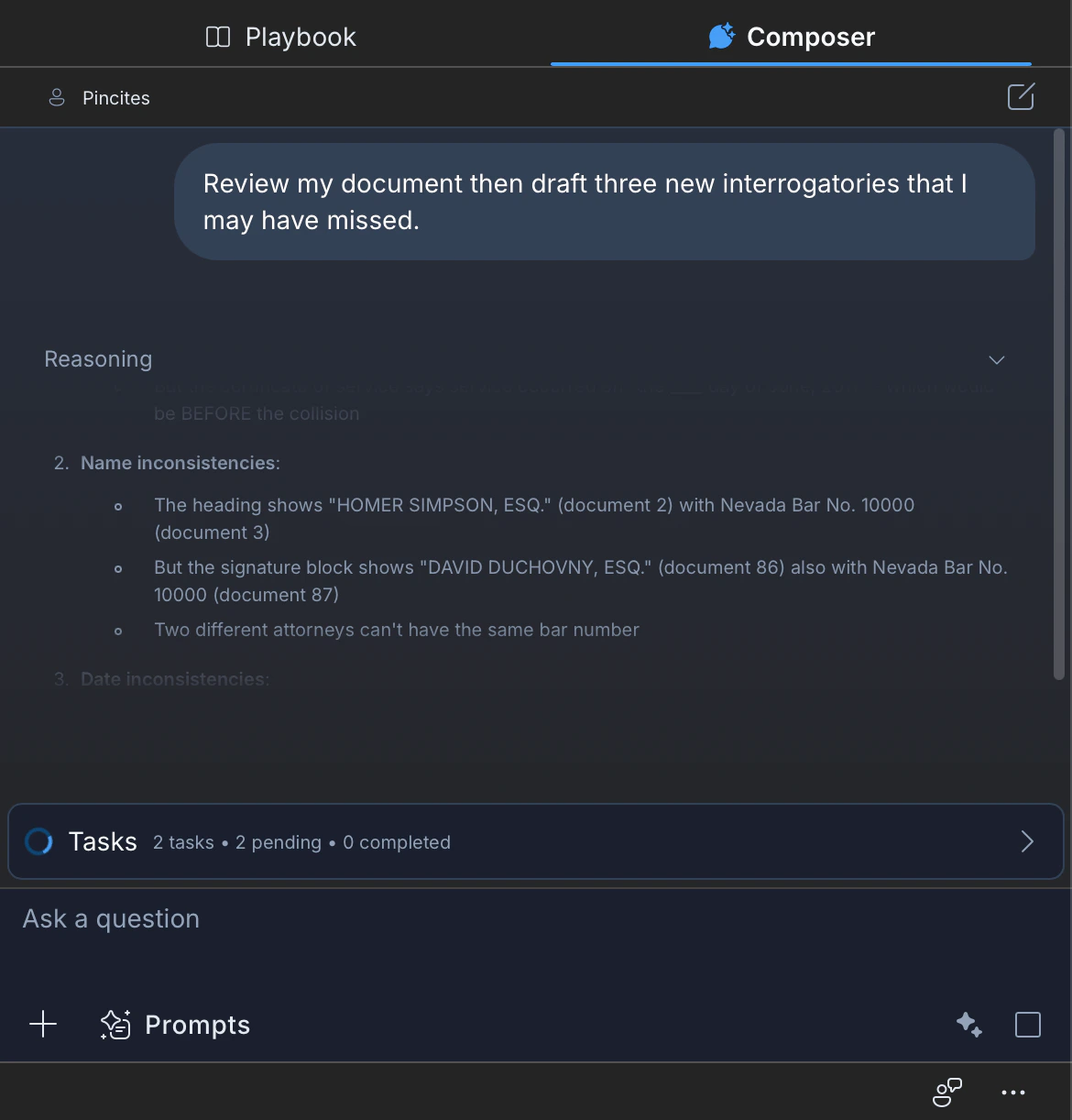
When you ask Composer to do something complex, like reviewing a full contract or researching a legal question, you'll notice it doesn't respond immediately. Instead, you'll see status indicators showing what it's working on. This is the Thinking phase.
## Why Composer pauses to think
Simple questions get fast answers. But contract review isn't simple. A request like "review this MSA for risk" requires Composer to:
* Read the entire document
* Identify which provisions matter
* Check each one against your standards
* Decide what needs to change
* Generate redlines with explanations
Doing all of this well requires planning. The Thinking phase is where that planning happens.
## What happens during thinking
Composer works through your request in stages:
**First, it breaks down the problem.** A broad request becomes a series of specific tasks. "Review for risk" turns into checks on indemnification, liability caps, termination rights, IP ownership, and so on.
**Then it makes a plan.** For research, this might mean formulating search queries. For contract review, it means deciding which clauses to examine and in what order.
**Then it executes.** Composer works through each planned step: reading sections, applying playbook rules, comparing against your template, or searching external sources.
**Finally, it synthesizes.** The findings from each step get combined into a coherent response with redlines, comments, or a summary.
## Status indicators
During thinking, you'll see what Composer is doing:
* Reading document
* Reviewing specific clauses
* Applying playbook
* Searching web sources
* Generating redlines
These indicators give you visibility into the process, not just the final output.
 ## The benefit of step-by-step processing
This approach takes longer than a single-pass response, but produces better results:
* Fewer errors because each step gets validated before the next one starts
* More thorough analysis because nothing gets skipped
* Clearer reasoning because the AI plans before it acts
* Better redlines because changes are informed by full document context
## When to expect thinking
Composer uses extended thinking for:
* Full contract reviews
* Multi-document comparisons
* Research requests
* Compliance checks
* Chained workflows (review → draft → summarize)
Quick factual questions ("What's the governing law?") skip the thinking phase and return immediate answers.
## The benefit of step-by-step processing
This approach takes longer than a single-pass response, but produces better results:
* Fewer errors because each step gets validated before the next one starts
* More thorough analysis because nothing gets skipped
* Clearer reasoning because the AI plans before it acts
* Better redlines because changes are informed by full document context
## When to expect thinking
Composer uses extended thinking for:
* Full contract reviews
* Multi-document comparisons
* Research requests
* Compliance checks
* Chained workflows (review → draft → summarize)
Quick factual questions ("What's the governing law?") skip the thinking phase and return immediate answers.